

| Key Takeaways:
Three-star reviews represent your most movable audience. These are customers who liked your core offer but hit a specific operational roadblock. While unmanaged neutral ratings trigger a steep “trust cliff” for prospective buyers, responding to them closes the expectation gap, increases overall ratings by an average of 0.12 stars, deters lazy 1-star rants and signals high operational activity to Google’s local search algorithms. • The Truth Layer: Prospective buyers skip scripted 5-star praise and emotional 1-star rants, reading 3-star reviews to discover the objective “truth layer” of your business. • The 70% Trust Cliff: Consumer trust plummets from 96% for a 4-star business down to 29% for a 3-star business, making neutral feedback a critical threshold for revenue growth. • The 3-Step Response Formula:: • Direct Rating and Psychological Lifts: Systematically replying to feedback delivers a net increase of 0.12 stars in average ratings overall while directly resolving consumer cognitive dissonance. • Google Local Map Pack Acceleration: Frequent, fast owner responses signal an active profile, which drives higher placement in local search engine map results. |
|---|
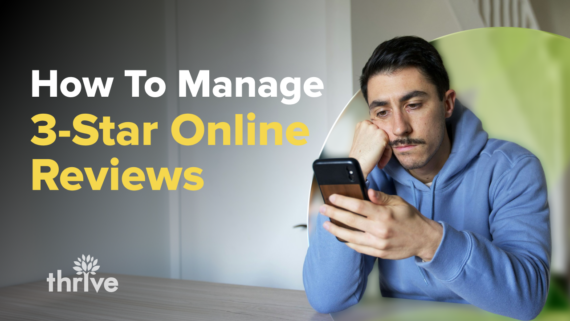
Three-star reviews are customer satisfaction limbo. Are they happy with your service? Is there a flaw you missed? Why didn’t you get the 5 stars? Why didn’t they give you a 1?
The “do-they-or-don’t-they” uncertainty keeps countless business owners up at night. Most businesses obsess over 1-star damage control or chasing 5-star praise. The 3-star reviewers, the customers who were this close to becoming loyal advocates, often get ignored.
That oversight costs real revenue. A single star is often the exact threshold between a business a customer will try and one they’ll pass on.
This guide breaks down everything you need to know about 3-star reviews by exploring:
• What a Three-Star Review Actually Means
• Understanding the Impact of Three-Star Reviews
• How To Respond to a Three-Star Review
• 10 Three-Star Review Response Examples
• How Responding Turns Neutral Reviews into Higher Ratings Across Platforms
What a Three-Star Review Actually Means
You might view a 3-star review as an unimpressed, uninvested or mid-response, but it’s actually more nuanced than that. When you build a targeted review response strategy around the psychology behind these neutral ratings, you unlock the ability to convert hesitant buyers into lifelong advocates.
 |
 |
 |
| 1-Star Reviewers Angry & Burned |
3-Star Reviewers Conflicted & Hesitant |
5-Star Reviewers Delighted & Loyal |
| They feel wronged by your business and want to punish you publicly. | They wanted to love their experience with you, but something specific held them back. | They love what you do and want to reward your business with praise. |
Three-star reviews are the most honest customer feedback you will receive. Emotionally, they liked your business enough to engage rather than walk away silently. But they were also so disappointed that they wouldn’t recommend you to friends.
Analyzing the 10 Types of Reviews
| Reviewer Type | Example Quote | What It Tells You About Your Business |
| 1. Great Product, Bad Experience | “The food was delicious, but we waited 45 minutes past our reservation time to get seated.” | Your core offering is strong, but front-of-house or service bottlenecks are eroding customer goodwill. |
| 2. “Good, Not Great” (Indifferent) | “Food was fine, service was fine. Nothing special, but nothing bad either.” | You lack a distinctive signature element or memorable touchpoint that converts casual visitors into loyal fans. |
| 3. Almost Perfect (One Dealbreaker) | “Loved the haircut and staff, but the salon floor was messy and there was hair on my chair.” | Quality control or hygiene standards are slipping during busy peak hours despite strong core skills. |
| 4. Price/Value Sensitive | “Nice atmosphere, but $40 for a small pasta dish feels overpriced for what you get.” | Your perceived value doesn’t match your price point, or your menu or offerings lack clear tiering. |
| 5. Competitor Comparer | “Decent gym, but [competitor] has much better cardio equipment for the same membership price.” | Local competitors are outpacing you on specific amenities or features that matter to high-intent buyers. |
| 6. The Conditional Loyalist | “Great coffee, but I wish they had oat milk options. I’d come here every morning if they did.” | Friction in your menu or service options is stopping high-frequency buyers from becoming daily regulars. |
| 7. Bad Communication | “The plumbing job was done well, but no one called to let me know the technician was running two hours late.” | Operations are solid on-site, but your notification and customer communication protocols are breaking down. |
| 8. Underwhelmed First-Timer | “First time trying this spot. It was okay, but I didn’t see what all the hype was about.” | Your onboarding or first-time customer experience isn’t guiding new guests toward your best offerings. |
| 9. The Feature Suggester | “Software works great for our team, but it really needs an auto-export feature to CSV.” | Power users love your core product but are hitting functional ceiling limits in their daily workflows. |
| 10. The Situational Victim | “Love this shop, but the road construction outside made parking an absolute nightmare today.” | External friction is spilling over into customer sentiment, requiring proactive expectations management. |
Understanding the Impact of Three-Star Reviews
Consumers don’t evaluate star ratings on a linear scale. Instead, consumer trust falls off a cliff the moment your rating dips into 3-star territory.
Consumer trust research reveals that 96% of consumers trust a 4-star business, but that number plunges to just 29% for a 3-star business. This means moving from 4 stars down to 3 is an approximately 70% collapse in trust.
This “trust cliff” creates a paradox for business owners because of how modern consumers evaluate customer feedback.
While a 3-star average rating damages your overall reputation, individual 3-star reviews are the exact feedback prospective buyers look for first. Buyers treat 3-star reviews as the “truth layer” of your business. They deliberately skip past glowing 5-star praise, which can feel scripted, and emotional 1-star rants, which often feel irrational. People want balanced and objective feedback, which is often found in 3-star reviews.
So, what’s the bottom line?
Three-star reviews won’t ruin you. But when you neglect responding to customer reviews, it tells every prospective buyer reading the “truth layer” that you don’t care enough to fix what broke.
How To Respond to a Three-Star Review
Now that we’ve examined the types of 3-star reviews and their impact on your business, it’s time to learn exactly how to respond to them.
Responding to negative reviews and 3-star feedback requires a deliberate balance: you must validate what went right while directly addressing what went wrong. Here’s an easy 3-step review response strategy:
• Step 1: Validate What Worked
Start by acknowledging the specific positive element they mentioned. This proves to both the reviewer and prospects that you read the feedback carefully. Jumping straight to the problem makes your business look defensive.
• Step 2: Own the Gap
Address the specific complaint head-on. If it was an operational hiccup, explain what went wrong and state clearly what you’ve done to fix it. Never argue, and avoid dismissive language like “we’re sorry you feel that way.”
• Step 3: Close the Loop
Invite them back with a specific reason. Reference a new update, product or improved process rather than dropping a generic “hope to see you again.”
The DO’s and DON’Ts of Responding to Neutral Feedback
| ✅ DO | ❌ DON’T |
| Thank them for specific positives mentioned in the review. | Jump straight to defending the business or making excuses. |
| Name the specific issue directly (e.g., “our wait times,” “the billing delay”). | Use dismissive language like “we’re sorry you feel that way.” |
| Highlight concrete fixes or operational changes you’ve made. | Make vague, meaningless promises like “we will strive to do better.” |
| Keep your response concise (2 to 4 sentences). | Write a long-winded essay that out-lengths the original review. |
| Personalize your note using details from their feedback. | Copy and paste a generic template for every 3-star review. |
| Invite them back with a compelling, specific reason. | End with a passive, forgettable “hope to see you again.” |
| Write for the future reader who is evaluating your customer service. | Argue with the reviewer to prove a point. |
10 Three-Star Review Response Examples
To help you put the 3-step formula into practice, here are 10 plug-and-play response templates organized by scenario, alongside the psychological reasoning for why each approach works.
| Scenario & Reviewer Type | Plug-and-Play Response Template | Why This Works |
| 1. Great Product, Bad Experience “The food was delicious, but we waited 45 minutes past our reservation time to get seated.” |
“Thanks for the kind words about [specific product/item], [Name], that means a lot to our team. The [wait time / service issue] you described isn’t our standard, and we sincerely apologize for the delay. We’ve [specific change made] to ensure smoother visits moving forward. We’d love another chance to show you the full 5-star experience next time.” | Reinforces what they loved about your core offering while showing future readers that you actively fix operational hiccups. |
| 2. “Good, Not Great” (Indifferent) “Food was fine, service was fine. Nothing special, but nothing bad either.”” |
“Thanks for coming in, [Name]. Hearing that your visit was just ‘fine’ tells us we didn’t give you a memorable reason to come back, and that’s on us. If you’re up for giving us another shot, try [specific signature service/item] on your next visit. It’s what our regulars swear by!” | Reframes indifference as an opportunity, proving to readers that you hold your team to a higher standard than “just okay.” |
| 3. Almost Perfect (One Dealbreaker) “Loved the haircut and staff, but the salon floor was messy and there was hair on my chair.” |
“Really glad you enjoyed [positive aspect], [Name]! You’re completely right that [specific issue] shouldn’t have been part of your visit. We’ve already [specific fix implemented]. That single issue shouldn’t overshadow an otherwise great experience, and we’d love to prove that to you on your next visit.” | Isolates the single point of failure, validates the customer’s frustration, and highlights a real-time operational fix. |
| 4. Price/Value Sensitive “Nice atmosphere, but $40 for a small pasta dish feels overpriced for what you get.” |
“Appreciate the honest feedback, [Name]. We hear you on value, and we want every interaction with us to feel 100% worth it. You might enjoy our [specific menu/package offer], which delivers the same high quality at a lower price point. Hope to see you again soon!” | Instead of getting defensive about pricing, it redirects the customer toward a higher-value alternative matching their budget. |
| 5. Competitor Comparer “Decent gym, but [Other Spot] has much better cardio equipment for the same membership price.” |
“Thanks for the honest feedback, [Name]. Detailed comparisons like yours push us to keep getting better. We’ve actually been working on upgrading our [specific feature/process], and we’d love for you to drop by and see the difference firsthand.” | Converts competitive pressure into public accountability, proving you are actively evolving to beat market standards. |
| 6. The Conditional Loyalist “Great coffee, but I wish they had oat milk options. I’d come here every morning if they did.” |
“Love hearing that, [Name], and we have great news! We’ve actually [added/implemented what they requested]. Feedback from customers like you directly helped us make that upgrade. Come back soon and check it out for yourself!” | Gives the customer the exact reason they needed to return, turning a neutral 3-star review into an immediate re-engagement win. |
| 7. Bad Communication “The plumbing job was done well, but no one called to let me know the technician was running two hours late.” |
“Thank you for bringing this to our attention, [Name]. You’re spot on, [unclear process/communication delay] isn’t acceptable. We’ve [updated our confirmation steps / trained our team] to ensure complete transparency going forward. Thanks for helping us improve.” | Owns the communication gap without making excuses, reassuring prospective clients that doing business with you is smooth and clear. |
| 8. Underwhelmed First-Timer “First time trying this spot. It was okay, but I didn’t see what all the hype was about.” |
“Thanks for giving us a try, [Name]! We know a first visit doesn’t always show off everything we do best. On your next visit, ask for [specific feature/recommendation]. It’s what we’re known for. We’d love the opportunity to turn ‘okay’ into ‘worth the trip’.” | Gives first-timers a curated, guided reason to give your business a second chance before their impression hardens. |
| 9. The Feature Suggester “Software works great for our team, but it really needs an auto-export feature to CSV.” |
“So glad to hear you enjoyed [positive aspect], [Name]! That’s a fantastic suggestion regarding [feature/improvement]. We’re actually in the process of rolling out [related update] in [timeframe], and your note confirms we’re heading in the right direction.” | Makes the customer feel heard as an insider and shows future readers that your business actively listens to community feedback. |
| 10. The Situational Victim “Love this shop, but the road construction outside made parking an absolute nightmare today.” |
“Thank you for the kind words about [positive aspect], [Name]. We completely understand how frustrating [construction / holiday rush / staffing delay] was during your visit. That situational issue is scheduled to be resolved by [date], and we’d love to welcome you back for a seamless experience.” | Separates a temporary, external disruption from your core business quality without invalidating the customer’s inconvenience. |
How Responding Turns Neutral Reviews into Higher Ratings Across Platforms
Responding to customer reviews is a simple strategy to grow your business. When you reply to 3-star reviews, you unlock two big advantages: you win back customers, and you boost your rank on search engines.
1. The Direct Rating Boost
People who leave 3-star reviews are on the fence. They don’t hate you, but they aren’t total fans yet either. A quick, thoughtful reply is often all it takes to tip them over to your side. Research from Harvard Business Review and consumer satisfaction studies shows why replying works:
• Your Overall Score Goes Up: Studies show that when business owners start replying to reviews, their average rating increases by 0.12 stars. That might sound small, but it can easily push a 3.8 average up to a 4.0.
• Fewer Emotional Rants: When people see an owner actively replying, they stop posting lazy 1-star complaints. Knowing a real person is reading makes people leave far more constructive feedback.
• You Fix the One Thing That Went Wrong: Most 3-star reviews are a “good idea, bad execution” story. When you reply and fix that one flaw, the customer feels heard and comes back.
• You Show Buyers You Can Be Trusted: New customers read your replies to see how you handle mistakes. A good response proves your business is honest and easy to deal with.
2. The Google Search Boost
Google wants to send users to active businesses. When someone searches for “best restaurant near me” or “top-rated plumber,” the platform’s local ranking algorithm evaluates hundreds of profile signals, and review response activity is a critical operational indicator.
When you consistently reply to 3-star reviews, you send direct signals to Google Business Profile (GBP) that your listing is monitored and active.

A single 3-star review is rarely a crisis, but a pattern of unmanaged 3-star feedback will quietly drag down your bottom line. When prospective customers search for your business, they are evaluating how you handle real-world mistakes.
So, don’t let middle-of-the-road feedback sit ignored on your profile. Set a daily routine around improving customer reviews by validating, responding to and closing out neutral feedback. This turns your 3-stars into a repeatable engine for trust and visibility.
Convert Undecided Buyers With Expert Customer Review Management
Managing neutral reviews requires speed and precision. These are two things busy internal teams rarely have time for. If left unmanaged, lukewarm feedback quietly drains buyer trust. On the flip side, manually writing customized replies steals valuable focus away from running your business.
Partnering with Thrive Internet Marketing Agency transforms your review section into a trusted growth engine. We identify hidden friction in your operational workflow and post targeted replies that turn prospects into clients. We also build a tailored review response strategy that fits your brand voice exactly. Our dedicated team handles sensitive customer feedback while optimizing every response to boost your local search visibility.
Protect your revenue and build lasting market authority with a modern review management strategy. Contact Thrive today.
Frequently Asked Questions About Online Customer Reviews
WHAT IS CUSTOMER REVIEW MANAGEMENT?
Customer online review management is the strategic process of monitoring and responding to client feedback across digital platforms. It ensures that a company actively protects its public reputation and projects a trustworthy image to prospective buyers evaluating the brand.
HOW CAN BUSINESSES EFFECTIVELY MANAGE CUSTOMER REVIEWS?
Businesses can effectively handle feedback by establishing a centralized monitoring system, assigning clear ownership to dedicated team members and creating consistent response protocols. Comprehensive customer review management combines real-time notifications with structured response templates to ensure every piece of feedback is acknowledged.
WHAT ARE THE BEST PRACTICES FOR ONLINE REVIEW MANAGEMENT?
The most effective approach relies on four core principles: continuous platform monitoring, objective tone control, operational accountability and systematic data analysis.
Teams should avoid defensive arguments, personalize every reply, log recurring complaints to fix back-end business processes and maintain a consistent response rate across all directories.
HOW SHOULD BUSINESSES RESPOND TO CUSTOMER REVIEWS?
When responding to customer reviews, businesses should use a balanced three-step approach:
• Validate the positive aspects mentioned,
• Own any operational gaps head-on without making excuses,
• Close the loop with a specific reason for the customer to return or engage again.
HOW QUICKLY SHOULD BUSINESSES RESPOND TO CUSTOMER REVIEWS?
The industry benchmark is to reply within 24 to 48 hours. Maintaining high speed is particularly critical when responding to negative reviews, as a fast reply prevents minor complaints from escalating.
HOW SHOULD BUSINESSES RESPOND TO NEGATIVE REVIEWS?
When responding to negative reviews, lead with empathy and acknowledge the specific issue directly. Avoid generic boilerplate phrasing or getting defensive.
WHAT IS THE BEST WAY TO RESPOND TO AN UNHAPPY CUSTOMER?
The best approach involves validating their frustration, offering a sincere apology and outlining an immediate solution. By showing that their voice actively drives concrete operational changes, you neutralize public tension.
HOW CAN BUSINESSES CREATE BETTER RESPONSES TO CUSTOMER REVIEWS?
Focus on replacing generic copy-paste templates with personalized, contextual replies that reference the specific service or product involved. Demonstrating genuine human attention is essential for improving customer reviews and building authentic credibility with prospective buyers.
WHAT MAKES A CUSTOMER REVIEW RESPONSE EFFECTIVE?
An effective response involves empathy and transparency. It addresses the reviewer’s unique experience in two to four punchy sentences while speaking directly to prospects reading the exchange, reinforcing the core standards of your online review management strategy.
HOW CAN BUSINESSES IMPROVE THEIR CUSTOMER REVIEWS?
Improving customer reviews starts with delivering great service, asking happy clients for feedback at the right moment, and using neutral ratings to fix operational flaws. This simple approach turns everyday customer experiences into a reliable stream of positive online feedback.