
Everything You Need
To Know About
AI Search
In This Series


Large language models (LLMs) and artificial intelligence (AI) powered search assistants, such as ChatGPT, Gemini and Google AI Overviews, are rewriting the rules of search engine optimization (SEO) faster than most of us can keep up.
AI models are steadily expanding their features, synthesizing information directly on search results pages. This means users are getting answers before they even land on your website.
The result? Website traffic is plummeting, lead volumes are drying up and revenue is slipping.
A Semrush study of 10,000 informational keywords revealed that AI-generated summaries are causing a sharp decline in both organic and paid click-through rates (CTRs).
This zero click search trend is rapidly accelerating across demographics, with nearly 60% of searches now ending without users ever clicking through to another website.
If your business isn’t showing up in AI powered search results, you’re not just missing clicks; you’re also losing customers.
This is the new reality. And it’s time we faced it together.
Let’s break down AI search and what you can do about it.


AI search leverages advanced natural language processing (NLP), machine learning (ML) and large language models to deliver faster, more personalized and hyper-relevant responses to user queries. Unlike traditional search engines, AI powered search decodes context, intent and semantic meaning rather than relying on exact keyword matches.
Let’s say you’re searching for the“best barbecue restaurants in Texas.”
Traditional search engines operate like librarians, cataloging information based on keyword matches and link popularity. For the example above, search engines might return a list of websites that highlight Texas’s popular barbecue joints alongside a couple of sponsored ads.
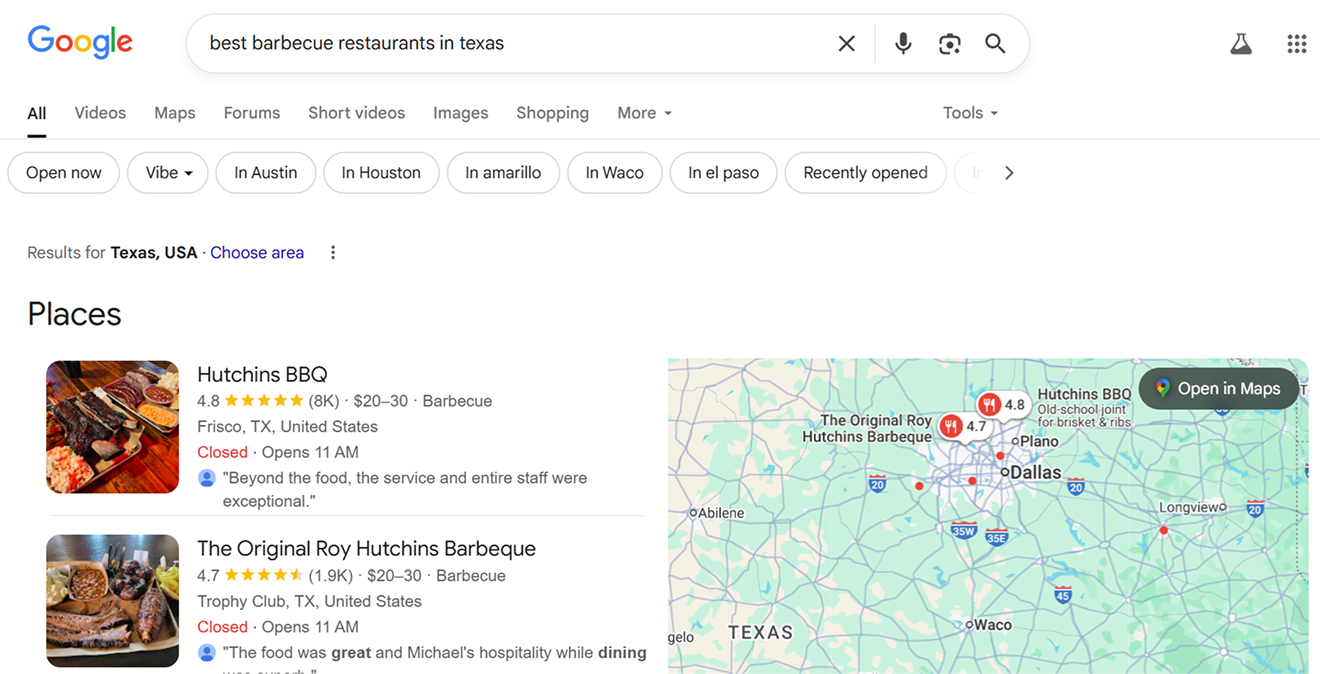
But AI search can go a step further.
Beyond keyword relevance, it can recognize that you’re likely looking for highly rated barbecue restaurants that meet specific needs. By factoring in your location, time of day and even past search behavior, it tailors the results to align with your personal preferences.



Large language models are the foundational technology that powers AI search experiences to provide more human-like interactions with users. Unlike traditional search engines, LLMs and AI powered search platforms often present comprehensive, conversational responses directly within the search interface, eliminating the need to scroll through organic results.
This shift toward zero click search is redefining user experiences and how businesses must position themselves to ensure AI visibility.
The most prominent AI models right now are:
| LLM/Search Tool | Provider | Strengths | Search Integration |
|---|---|---|---|
 ChatGPT ChatGPT |
 |
|
Uses Bing Search API |
 Gemini Gemini |
 |
|
Powers Google AI Mode and AI Overviews |
 Google AI Overviews Google AI Overviews |
|
|
Core feature in Google Search AI experience |
| Google AI Mode |
|
|
Embedded in the Google Search AI experience |
| OTHER LLMs | |||
 Perplexity Perplexity |
 |
|
Standalone AI search/chat engine |
 Claude Claude |
 |
|
Web search capability in the Claude interface |
 Microsoft Copilot Microsoft Copilot |
 |
|
Powered by Bing Search integration |


AI search systems process information at multiple levels. They combine various technologies to understand human language, retrieve relevant information based on previous interactions and generate accurate responses.
Here’s a breakdown of the core technologies and processes behind Google AI search and other AI models:
HOW AI SEARCH WORKS
Data Collection
Web crawling, analyzing user interactions, databases, documents, real-time feeds, etc.
Natural Language Processing (NLP)
Tokenization, part-of-speech tagging, lemmatization and stemming, named entity recognition
Machine Learning Algorithms
Supervised learning, unsupervised learning, reinforcement learning
Large Language Models (LLMs)
Contextual understanding, semantic analysis
Predictive Analytics
Autocomplete queries, surface content that aligns with user intent
Retrieval-Augmented Generation (RAG)
Vector search, knowledge retrieval, context integration
Continuous Learning & Feedback Loops
Query refinements, model updates, performance optimization
1. Data Collection
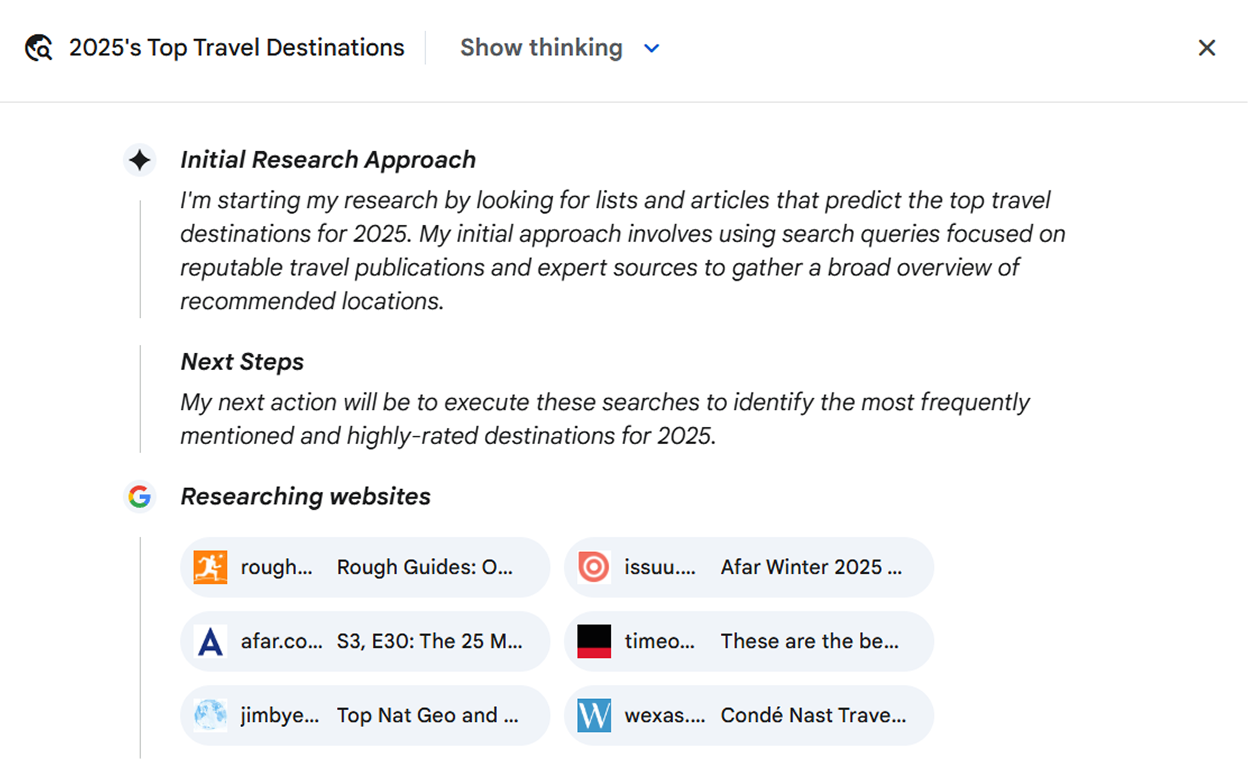
AI models pull information from a wide array of sources, including traditional web crawling, structured databases, documents, user interactions, real-time news feeds and multimedia inputs such as images and videos. This broad ingestion of data allows AI search systems to build an up-to-date knowledge base.
Here’s an example showing how Gemini pulls information from various online sources:
2. Natural Language Processing (NLP)
NLP transforms unstructured text into structured data that AI can analyze. This allows the AI models to understand context, intent and meaning and handle conversational queries and complex questions.
NLP involves:
- Tokenization – Breaking text into words or phrases
- Part-of-speech tagging – Labeling nouns, verbs and adjectives
- Lemmatization and stemming – Reducing words to their base form
- Named entity recognition – Identifying people, places, organizations, etc.
For example, let’s search on Google AI Mode, “Will I need an umbrella in Seattle this weekend?”

The NLP system recognizes that this is a weather-related question even though you didn’t indicate the words “weather forecast” or “rain.” It understands the intent rather than focusing on the exact words used and pulls real-time weather data to answer your question accurately.
3. Machine Learning (ML)
Machine learning uses data and algorithms to mimic human learning. This allows Google AI search and other LLMs to refine search relevance and make decisions without human intervention.
3 Types of Machine Learning:
- Supervised learning – Trained on labeled datasets; you’re feeding the algorithm information to help it learn.
- Unsupervised learning – Finds patterns in unlabeled data before grouping them into several clusters.
- Reinforcement learning – Improves through feedback loops.
For example, ChatGPT fine-tunes its suggestions based on what users click or ask next. Google AI Mode uses reinforcement learning from user interactions to refine future answers, making every search smarter over time.
4. Large Language Models (LLMs)
LLMs, such as GPT5.1 or Gemini, bring contextual understanding and semantic analysis to search queries. Rather than simply matching strings of text, LLMs analyze the intent and deeper meaning behind a user’s query and cross-reference it against vast internal knowledge bases. They understand nuance, tone and even follow-up context, allowing for rich, human-like conversation and responses.
For example, when you ask Gemini, “What’s the safest car for a family of five?”

Instead of just matching the keywords and listing cars, Gemini synthesizes safety ratings, user reviews and space requirements to offer a comprehensive answer.
5. Predictive Analytics
Predictive analytics analyzes patterns in past searches and user behavior to help users find the information they need faster and with fewer clicks than ever before.
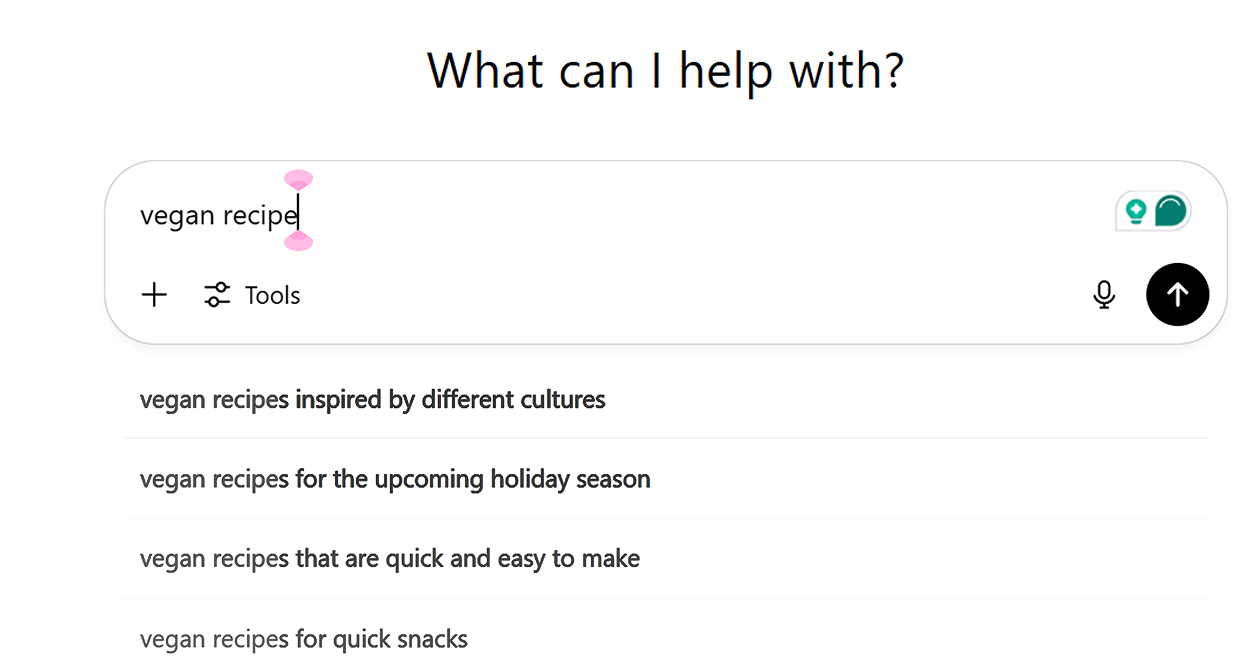
This includes:
- Autocomplete suggestions
- Predictive query expansion
- Surfacing content that aligns with historical search intent
For instance, if a user often searches for vegan recipes, ChatGPT and other LLMs will surface similar content or complete suggestions like “vegan recipes inspired by different cultures” or “vegan recipes for quick snacks.”
6. Retrieval-Augmented Generation (RAG)
RAG combines the contextual understanding of language models with real-time knowledge retrieval to produce up-to-date answers.
The system performs vector-based searches (capturing the meaning and context of unstructured data and transforming it into a numeric representation) across indexed databases to retrieve relevant documents. It then uses the language model to produce a coherent, comprehensive response.
This reduces the risk of AI hallucinations or generating incorrect, misleading or nonsensical information.
Many AI models, such as ChatGPT, Gemini and Perplexity, use RAG to display citations alongside each response.
For example, if you search for the “best hiking trails in the U.S.,” ChatGPT might retrieve a passage from a website and cite it directly in an answer. This boosts the site’s visibility even if the content isn’t ranked #1 on traditional search engines.

7. Continuous Learning and Feedback Loops
AI search doesn’t stop learning after deployment. It continuously improves through feedback loops and performance monitoring.
Every user query and interaction provides data that the system can use to fine-tune its models. This includes adjusting ranking algorithms, updating training data, refining autocomplete suggestions and even re-weighting certain data sources.
These query refinements and model updates ensure the AI remains accurate and responsive to evolving user needs and language patterns.


Zero click searches are becoming the norm.
You’ve probably searched for something on Google recently, and chances are you got the answer at the top of the page without clicking on a link. Maybe it was a “People Also Ask” dropdown, a local map with business details or a bold snippet with a clear answer. Or you may have turned to ChatGPT Search or Gemini to get a quick product comparison.
This is what we call a zero click search. It’s when users get all the information they need directly from the search engine or AI platform without ever visiting a website.
While the rise of Google AI search results represents a move towards convenience for users, it’s shaking things up for businesses across industries. A Pew Research Center report revealed that Google users are more inclined to end their browsing session after viewing a search result that includes an AI-generated summary compared to results that don’t feature one.
Google search powered by generative AI is reshaping the search environment in real time. More than ever, mastering how to rank in AI search is a skill you can’t afford to overlook.
Let’s look at the statistics:
- Around 1 in 5 Google searches produces an AI summary (Pew Research Center).
- AI search traffic delivers 4.4X higher value than organic search (Semrush).
- 3 in 4 people have experienced at least one piece of inaccurate or misleading content in an AI Overview (Exploding Topics).
- AI algorithms can increase leads by as much as 50% (Harvard Business Review).
- More than 50% of Americans use voice assistants to gather information (Edison Research).
- 8.5% of people believe they can “always trust” AI Overviews when searching online (Exploding Topics).
- Only 18.6% of users always click through to the sources linked in AI Overviews (Exploding Topics).
- 28.98% of people believe that Google AI search results are better than they’ve ever been (Exploding Topics).
- Given the chance, only 36.6% of people would disable AI Overviews (Exploding Topics).


The short answer is no. Google AI search results and AI-generated responses are not the end of search engine optimization (SEO). In fact, it’s the opposite. Zero click searches are creating new opportunities for brands that know how to adapt.
Let’s dive deeper.

Case Study: HubSpot’s Traffic Collapse
In May 2024, HubSpot revealed that it had lost a staggering 33% of its organic traffic due to changes in Google Search, particularly the rollout of AI Overviews and the rise of zero-click searches. HubSpot wasn’t alone, but the scale of its traffic decline (about 4.3 million monthly visits) sent shockwaves through the marketing world.
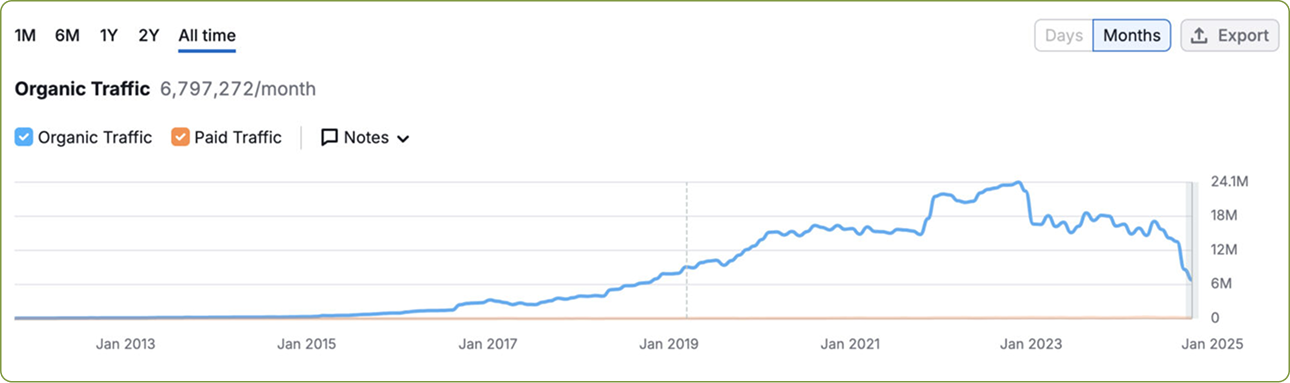
Image Source: Search Engine Land
For years, HubSpot was considered a gold standard in SEO. They dominated SERPs and their content strategy was meticulously executed and often imitated by countless other brands and websites.
But as Google shifts to generative AI search and more people use AI models to search for information, the HubSpot case proves that no brand, no matter how big, is immune to AI’s impact.
In the next few years, LLMs are projected to drive as much business value as traditional search and surpass it soon after.
Estimated LLMs vs. Organic Search Value
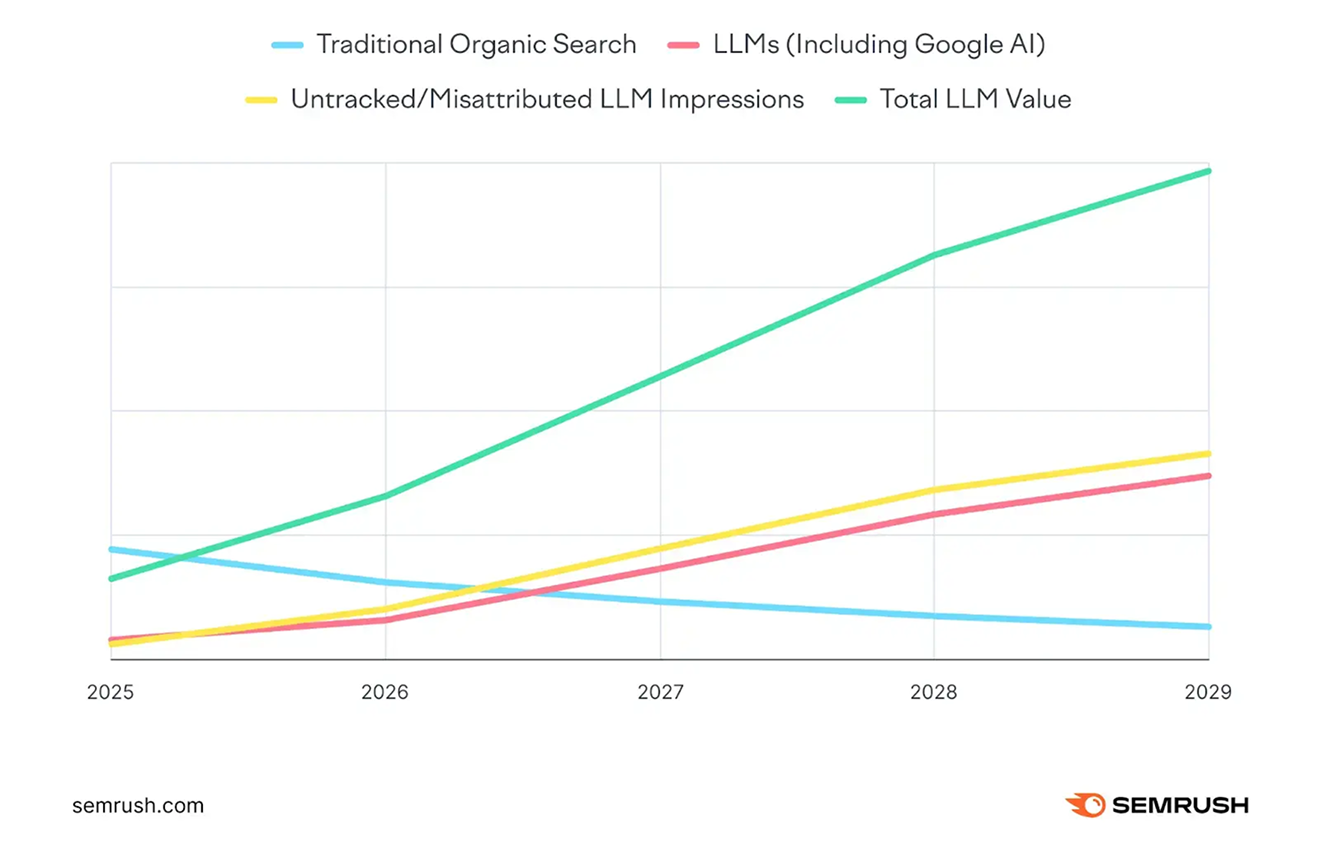
Image Source: Semrush


What’s happening is a major pivot in the goal of SEO. Instead of focusing mainly on keyword rankings, click-through rates (CTRs) and traffic, brands must now aim for something even bigger: AI trust and visibility.
Here’s the reality:
AI and the Future of SEO Is About Trust
Think of it like a digital credit score. In finance, banking institutions evaluate the “creditworthiness” of a person applying for a loan based on various factors, including payment history and account age.
The same concept is now being applied in Google AI search and other AI systems.
Just like a bank doesn’t approve a loan based solely on your income, LLMs don’t surface your content based only on keyword usage or backlinks anymore. Instead, they evaluate the overall trustworthiness of your online presence or what we could call your “Digital Credibility Score.” This includes your brand authority, topical expertise, technical integrity and consistency across the web.
Your Content Still Powers AI Results
Zero-click summaries still rely on third-party sources to synthesize their responses. If your site provides high-quality, relevant information, it can influence the AI answer, even if the click never happens.
Brand Mentions Can Drive Indirect Conversions
Some AI-generated responses and Google’s generative AI search results display citations. Repeated exposure in these summaries builds trust and familiarity, which pays off over time.
Clicks Still Happen (Just Not Like Before)
While zero-click searches dominate, “high-intent” users still click, especially on comparison content, product reviews and long-tail queries. Smartly structured content can still earn traffic if optimized correctly.
Forward-thinking marketers are already adjusting their strategies to turn AI visibility into a competitive edge. Don’t get left behind.

Traditional SEO practices, which have dominated digital marketing for over two decades, are now being challenged by the emergence of AI-powered search technologies. This fundamental change requires marketers and businesses to reconsider their optimization strategies.
| Traditional SEO | AI Search SEO (ChatGPT Search, Gemini, etc.) |
|
|---|---|---|
| Primary Goal |
|
|
| Search Method |
|
|
| Content Focus |
|
|
| Keyword Strategy |
|
|
| User Journey |
|
|
| Success Metrics |
|
|
It’s the end of SEO as we know it, but the beginning of generative engine optimization (GEO).

Generative engine optimization, more commonly referred to as AI search SEO or just simply AI SEO, is the process of optimizing your digital presence to boost visibility within AI-powered search platforms and generative engines.
Unlike traditional SEO, which focuses on ranking web pages in SERPs, GEO helps LLMs understand and synthesize your content when responding to user queries.
Despite the shift to generative AI SEO, the core principles of traditional optimization remain as relevant as ever.
What’s Changed With AI Search:
AI Prompts Has Transformed Keyword-Based Queries Into Natural Prompts
Traditional search engines taught users to think in keywords. Users stripped their queries down because search engines could only understand basic terms. With LLMs and Google’s generative AI search, people now write searches as if they’re talking to another person. ChatGPT prompts, for instance, average 23 words – almost 5X longer than old-style searches.
SEO Has Shifted From Targeting Keywords to Understanding User Intent
Traditional SEO focused heavily on keyword density and exact-match optimization. AI search SEO shifts this focus toward understanding and addressing user intent. Instead of targeting specific keywords, successful content now addresses entire topic clusters and anticipates related questions users might have. This semantic approach aligns with how AI systems understand and categorize content.
AI Systems Now Prioritize Entities Over Individual Web Pages
AI systems think in terms of entities (i.e., people, places, things and concepts) rather than individual web pages. This entity-based understanding means that AI optimization strategies must consider how content relates to broader topics and how it establishes topical authority within specific domains. The most successful content creates clear connections between related concepts and demonstrates a comprehensive understanding of the subject matter.
AI Search Optimization Focuses on Visibility and Citations, Not Rankings and Traffic
Traditional SEO aims to achieve high rankings in search results and drive more users to your site. AI search optimization focuses on becoming the source that AI systems cite, reference and feature in their responses. This requires content that is not only comprehensive but also clearly structured, factually accurate and easily attributable.
What Hasn’t Changed:
Human Nature and Core Search Behavior Remain the Same
The psychological principles that drive search behavior, including curiosity, problem-solving and decision-making, remain constant. Whether someone is typing a query into Google or ChatGPT or asking a voice assistant, they’re fundamentally seeking to bridge a knowledge gap. This means that marketers who understand and address these underlying needs will continue to succeed regardless of technological changes.
Expertise and Authority Still Define Trust and Visibility
The concept of Experience, Expertise, Authoritativeness and Trustworthiness (E-E-A-T) has become even more critical in AI SEO optimization. AI models increasingly rely on these credibility signals to determine what content is relevant to user queries.
A Seamless User Experience Continues To Influence SEO Success
Site speed, mobile responsiveness, clear navigation and intuitive design remain crucial factors. AI systems, like their predecessors, use engagement signals and user behavior data to assess content quality. A website that frustrates users with poor performance or confusing layouts will struggle regardless of how well it’s optimized for LLMs and Google’s generative AI search.


Over 100 million people use ChatGPT daily and nearly 65% of searches now trigger an AI Overview. Rather than competing with Google search and generative AI-generated summaries, you must adapt and leverage the opportunity to optimize your brand presence and rank in these AI results.
Feeling overwhelmed by this rapid shift to generative AI SEO?
Here’s the good news: We’ve already mapped the way forward.
How Thrive Achieved 4,302%+ Growth in AI Traffic
Thrive’s Demand Generation team has been actively testing and refining AI search optimization strategies since the earliest emergence of AI models. For months, we’ve run data-backed experiments across multiple AI platforms to determine exactly what drives visibility, traffic and conversions in this zero-click search world.
The results speak for themselves. From January to October of 2025, our AI SEO optimization strategies drove remarkable results:
+4,302%
Total AI Referral Traffic
+322%
Gemini Traffic
+862%
ChatGPT Search Traffic
+101%
Perplexity Traffic
+3,017%
Claude Traffic
While many businesses are still scrambling to figure out what works, we’ve already done the work ourselves. We know what moves the needle and we can help you apply those AI SEO optimization strategies to ensure AI visibility.
We’re already helping clients achieve similar results. For this industrial equipment manufacturer, Thrive helped its products be highly recommended across leading large language models, including a 68% increase in ChatGPT traffic.
HOW TO OPTIMIZE FOR AI SEARCH
1. Build Deep Topical Authority
AI models favor sources that show consistent, in-depth knowledge of a subject rather than surface-level coverage. Rather than just targeting isolated keywords, double down on comprehensive, unique content that offers real value to your target audience.
Some tips on how to rank in AI search and become an indispensable source of information:
- Provide insightful analysis, in-depth case studies and/or practical first-hand experiences.
- Craft content that answers user queries naturally.
- Focus on long-form content that answers follow-up questions.
- Include FAQs, definitions and summaries that AI models can easily extract.
- Optimize for long-tail queries.
- Regularly update content with fresh insights and data.
2. Cultivate a Strong and Positive Brand Reputation
AI and the future of SEO don’t just revolve around what’s on your website. AI models also factor in brand signals from across the web, including third-party reviews and mentions. Building and maintaining a positive digital footprint allows AI models to recognize your brand as a trustworthy source of information.
Here are AI optimization tips on how to become the brand that AI cites:
- Actively manage your Google Business Profile and local directories.
- Maintain consistent name, address and phone (NAP) information across all platforms.
- Proactively request and respond to reviews on Google and niche sites.
- Showcase testimonials and case studies prominently on your website and social media platforms.
Thrive Local’s AI-powered reputation management software streamlines review generation and management for businesses across multiple locations and channels. The platform’s integration capabilities will allow you to build a consistent, positive digital footprint that AI models increasingly rely on to determine which content to cite in their responses.
3. Ensure Your Website Is Technically Flawless
Publishing high-quality content won’t help if your website is a clunker. Technical optimization remains a vital AI SEO strategy. It ensures AI models can efficiently crawl and cite your content.
Some tips on how to optimize for AI search:
- Ensure your website is mobile-responsive.
- Implement schema markup.
- Fix crawl errors and improve site speed and performance.
- Optimize image alt text and meta descriptions to align with the page’s main intent.
4. Build Authoritative Backlinks
Quality backlinks from reputable sources signal to AI models that your content is trustworthy and valuable. Digital PR and link building help earn these mentions in the right places, feeding the content ecosystem that AI models are trained on.
Ways to earn high-value backlinks:
- Focus on relevance over quantity.
- Create original research, surveys or reports that others will want to cite.
- Guest post on high-authority blogs or news platforms in your niche.
- Produce link-worthy content such as comparison guides and toolkits.
- Use tools, such as Ahrefs or Semrush, to identify backlink gaps with competitors.
- Respond to journalist requests through HARO.
5. Maximize Your Multimedia Presence
AI search is becoming increasingly multimodal. This means it pulls and interprets not just text but also images, videos, audio and uploaded files. A strong multimedia presence expands your digital footprint, helping you rank across more formats and platforms.
Here’s how to leverage multimedia for generative AI SEO:
- Create YouTube content, including instructional videos, product demonstrations, interviews, etc.
- Embed video summaries into your blog posts.
- Share and repurpose visual assets on social media platforms.
- Maintain consistent branding across all platforms.
- Ensure all multimedia content is mobile-friendly.


Remember when SEO was (relatively) simple? People would type certain keywords into Google, you’d track your rankings for those specific terms and success was measured by how high you appeared on page one.
If you ranked #3 for “best pizza NYC,” you knew exactly where you stood. Your analytics dashboard showed clear metrics, such as keyword positions, click-through rates and organic traffic.
The formula was simple: rank higher → get more traffic → drive more revenue.
As we shift our focus to generative AI SEO, we must also rethink how we measure visibility, authority and performance.
HOW TO MEASURE AI SEARCH VISIBILITY
1. Manual Query Testing
Begin with a manual AI visibility analysis of your target keywords across different LLMs. This AI SEO strategy requires careful planning rather than random testing.
Create a testing framework that includes:
| Type of Query | Description | Example |
|---|---|---|
| Core Business Queries | Direct questions about your products or services | “How much does solar installation for residential homes cost?” |
| Problem-Solving Queries | Questions your target audience asks when seeking solutions relevant to your offerings | “How can I reduce my electricity bill with solar panels?” |
| Comparison Queries | “Best [category] in [location]” type searches | “Best solar panel installation company in Phoenix” |
| Informational Queries | Educational content related to your industry | “How do solar panels work?” |
Test these queries across multiple AI models weekly, documenting which platforms mention your brand, how you’re positioned and what context surrounds your citations.
Since AI interprets queries differently than traditional search, test multiple variations of the same concept. Each variation might trigger different AI responses and reveal different aspects of your visibility.
For example:
- “Best solar installation company in Phoenix”
- “Where to find a reliable solar company in Phoenix”
- “Top-rated solar installation contractor in Scottsdale”
- “Phoenix solar installation services recommendations”
2. AI Search Monitoring Tool Integration
Without proper tracking, you’re essentially flying blind in the new AI-driven search environment. The following LLM tracking tools can help you monitor your AI visibility and gain actionable insights to improve your brand positioning.
| Tool | AI Platforms Covered | Key Features |
|---|---|---|
 Google Search Console Google Search Console |
|
|
 Semrush Semrush |
|
|
 Ahrefs Ahrefs |
|
|
3. Performance Impact Analysis
Establish baseline metrics before implementing AI SEO optimization strategies to measure incremental impact. Keep in mind, however, that AI search affects organic traffic differently from SEO.
Track assisted conversions, brand awareness metrics and cross-channel performance to understand the full spectrum of AI search influence on your digital marketing performance. These include:
- Referral traffic from LLMs
- Branded search performance
- Long-tail traffic changes
- Multi-touch attribution


AI SEO optimization is still in its infancy, with the technology, tools and methodologies rapidly evolving.
The approach that works today may need significant adjustment as AI models develop new features and algorithms.
Stay adaptable by:
- Monitoring platform updates
- Participating in industry discussions
- Experimenting with different tools and methodologies
Organizations that embrace generative engine optimization early are positioning themselves to capture disproportionate benefits as AI-powered search becomes mainstream.
The competitive advantage of having an AI SEO strategy extends beyond immediate visibility gains. Companies that master GEO are building sustainable, long-term assets that become more valuable as AI adoption accelerates. Proactive AI search optimization allows you to establish thought leadership and become the go-to source for LLMs across an entire industry or niche.
Thrive Internet Marketing Agency has successfully navigated through more than two decades of technological evolution from the invention of the iPhone, the rise of Google and to now, the AI revolution.
As AI search becomes the new norm, Thrive is leading the charge to help businesses adapt and stay ahead. Contact us today to discuss strategies on how to rank in AI search.
Frequently Asked Questions About AI Search
WHAT IS ZERO CLICK SEARCH?
Zero click search occurs when users get the information they need directly on the search results page without clicking through to any website. This can negatively impact your SEO in some cases and result in less web traffic. To stay competitive, you must adjust your SEO strategy and focus on retaining AI visibility.
WHAT PLATFORMS ARE LEADING IN AI SEARCH?
The most prominent large language models and AI-powered search assistants include ChatGPT (OpenAI), Gemini (Google), Google AI Overviews, Google AI Mode, Perplexity AI, Claude (Anthropic) and Microsoft Copilot. Each platform has unique features and requires a strategic AI search optimization approach.
WHAT IS GENERATIVE ENGINE OPTIMIZATION (GEO) AND WHY IS IT IMPORTANT?
Generative engine optimization is the practice of optimizing content to appear in AI-generated search results and summaries. As LLMs increasingly provide direct answers rather than traditional link lists, GEO becomes crucial for maintaining brand visibility.
WHAT ARE THE KEY FACTORS INFLUENCING AI CITATION FREQUENCY?
AI citation frequency refers to how often your brand is cited or referenced by LLMs and AI-powered search assistants when generating summaries or answers. The following factors contribute to the likelihood of getting cited in Google AI search and other LLMs:
- Topical relevance and authority
- Content structure and formatting
- Semantic alignment with user queries
- Originality and clarity
- Engagement and credibility signals
HOW CAN I OPTIMIZE MY CONTENT FOR AI SEARCH?
To optimize your content for AI search:
- Focus on clarity, structure and relevance.
- Use question-and-answer formats, concise paragraphs and subheadings.
- Include schema markup and structured data to help Google AI Search understand your content.
- Align your language with natural queries to match AI-powered search interpretation.
- Ensure fast loading speed, mobile responsiveness and semantic richness.
These factors improve AI search optimization and make your content easier to summarize by Google Search AI and other LLMs.
WHY IS BRAND REPUTATION IMPORTANT FOR AI SEARCH?
AI models factor in brand signals from across the web, including third-party reviews, mentions and overall digital footprint when determining trustworthy sources. A strong brand reputation helps AI systems recognize your brand as credible.
ARE THERE PLATFORM-SPECIFIC TACTICS FOR GENERATIVE AI SEO?
Yes, different LLMs require tailored approaches to generative AI SEO. The key is ensuring your content is valuable enough to be referenced and linked to in AI search results.
WHY SHOULD I FOCUS ON MULTIMEDIA CONTENT FOR AI SEARCH?
AI search is becoming increasingly multimodal, interpreting not just text but also images, videos and audio. A strong multimedia presence expands your digital footprint and helps you rank across more formats.
HOW CAN I MEASURE THE PERFORMANCE OF MY AI SEO OPTIMIZATION EFFORTS?
Measuring AI SEO optimization performance requires tracking metrics beyond traditional SEO indicators. Monitor your brand mentions and citations in AI-generated search results across different platforms. Track your visibility in featured snippets, knowledge panels and AI-generated answer boxes. Use tools that can monitor when your content appears in AI search results and how frequently you’re cited as a source.